







It’s the 25th of the month. You received your salary on the 1st, yet your bank balance is already nearing zero. You haven’t been overspending—rent, groceries, a few outings, a mobile recharge, and some “small” UPI payments have quietly drained everything.
If this sounds familiar, you’re not alone—and it’s something that can be fixed. Learning to save money is less about earning more and more about developing a few simple habits.
In this guide, you’ll learn why saving is important, how it differs from investing, how much to start with, and which habits work best for beginners. You’ll also find a practical, numbers-based example to help you get started this very month.
- Why Saving Money Matters
- Saving vs Investing: What’s the Difference?
- How Much Should You Save Each Month?
- 8 Money-Saving Habits That Actually Work
- A Beginner Example: ₹3,000 a Month for 5 Years
- Where to Keep Your Savings in India
- Common Beginner Mistakes to Avoid
- our 30-Day Saving Starter Plan
- Frequently Asked Questions
- Conclusion: Start Small, Stay Consistent
Why Saving Money Matters
Saving is the foundation for every other financial goal. Without it, an unexpected bill could land you in debt.
Regular personal savings provide you with the following:
- A safety net: Medical bills, a gap in employment, or a broken phone won’t force you to borrow money.
- Reduced stress: Knowing that you have a financial cushion makes daily decision-making calmer.
- Freedom of choice: You can leave an unsatisfactory job, pursue a course, or plan a trip without panic.
- A foundation for your goals: Whether it’s buying a bike, pursuing higher education, getting married, or making a down payment on a home—everything starts with saved money.
- A starting point for investing: You cannot invest consistently if you don’t have extra funds to begin with.
Takeaway: Saving does not mean being overly restrictive. It provides you with choices and peace of mind.
Saving vs Investing: What’s the Difference?
Beginners often confuse the two. Both are beneficial, but they serve different purposes.
Saving means setting aside money in a secure, easily accessible place. Your goal is to keep the funds safe and available whenever you need them.
Investing means putting money into assets—such as mutual funds or stocks—with the aim of growing it over the long term. Your objective is to increase your wealth, and you take on a certain level of risk to achieve this.
| Saving | Investing | |
|---|---|---|
| Main goal | Safety and quick access | Long-term growth |
| Time frame | Now to about 3 years | Usually 5+ years |
| Risk | Low | Low to high; value can fall |
| Examples | Savings account, recurring deposit (RD), cash | Mutual funds, stocks, PPF (long lock-in) |
| Best for | Emergency fund, near-term goals | Retirement, long-term wealth |
A simple approach to follow is: save first, then invest. Before putting money into anything that might fluctuate in value, ensure you have a financial cushion for emergencies.
The Public Provident Fund (PPF) falls somewhere in between. It is government-backed, but your money remains locked for 15 years; therefore, it is better suited for long-term goals rather than as an emergency fund.
This information is for general educational purposes only and does not constitute personal financial advice. For investment decisions, consider consulting a SEBI-registered advisor.
How Much Should You Save Each Month?
There is no single perfect number, but there are starting points for the work.
Start with whatever you can
If your budget is tight, don’t wait for the “perfect” amount. Start with ₹500 or ₹1,000 each month. The habit matters more than the initial amount. You can always increase the contribution as your income grows.
Try the 50-30-20 rule
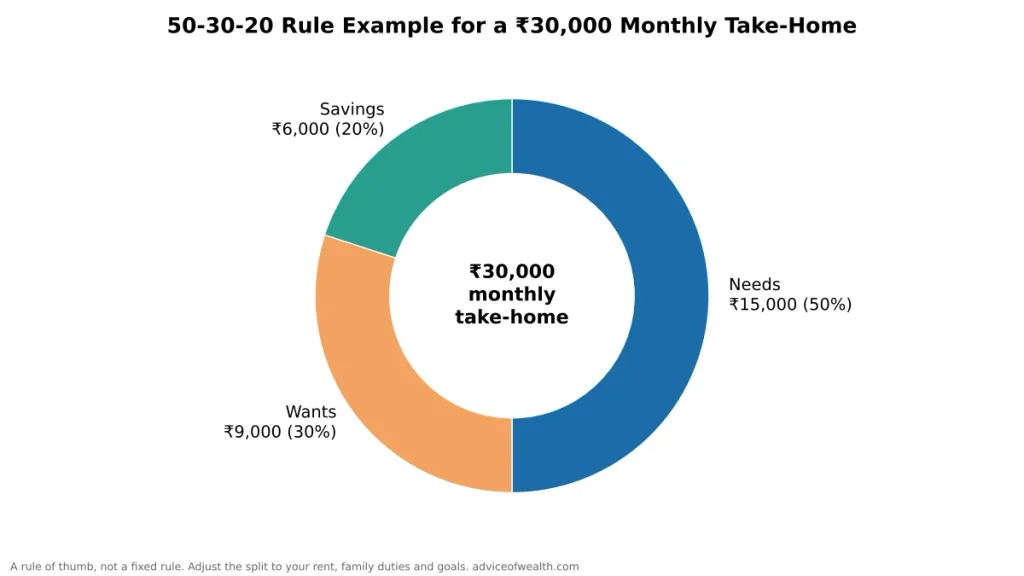
This is a general rule, not a law. It divides your take-home salary into three parts:
- 50% for needs: rent, groceries, bills, EMIs, and transport
- 30% for wants: dining out, shopping, subscriptions, and travel
- 20% for savings and debt repayment
If someone takes home ₹30,000 per month, it would look like this:
| Category | Share | Amount |
|---|---|---|
| Needs | 50% | ₹15,000 |
| Wants | 30% | ₹9,000 |
| Savings | 20% | ₹6,000 |
In many Indian cities, rent alone can consume half of one’s salary. If allocating 20% feels impossible, start with 5–10% and increase it gradually. You can learn how to plan these figures in our guide to creating a monthly budget.
Know your starting goal: the emergency fund
A common guideline is to set aside 3 to 6 months’ worth of essential expenses for emergencies. If your monthly essential expenses amount to ₹15,000, this means saving between ₹45,000 and ₹90,000.
Don’t be intimidated by this figure; build it up in stages:
- First milestone: ₹5,000 to ₹10,000 (to cover minor, unexpected setbacks)
- Second milestone: One month’s worth of expenses
- Final target: 3–6 months’ worth of expenses
Those with stable, salaried jobs can generally manage with about 3 months’ worth of savings. Freelancers, or those with dependents, typically need closer to 6 months’ worth.
8 Money-Saving Habits That Actually Work
Good money-saving habits are small, repeatable, and automatic. Here are eight such habits that are perfect for beginners.
1. Pay yourself first
Do not save what remains after your expenses, because usually, nothing is left. On payday, set aside your savings amount before you begin spending.
2. Automate it
Set up an automatic transfer to a separate savings account or a recurring deposit (RD) for the day after your salary arrives. You cannot spend money that you never even see.
3. Keep savings in a separate account
When savings and expenses are mixed, savings tend to decrease. Open a separate account exclusively for this purpose, and use it only for emergencies or essential needs.
4. Know where your money goes
You cannot fix leaks that you cannot see. Track your spending for just one month, and you will discover unexpected items, such as unused subscriptions or daily delivery fees. Our guide on how to track expenses shows you an easy way to do this.
5. Use the 48-hour rule for non-essential purchases
When you want something that isn’t essential, wait 48 hours. By then, many impulse purchases lose their appeal.
6. Cut one recurring cost at a time
Don’t try to change everything at once. Review one item each month—such as unused OTT subscriptions, an expensive mobile plan, or extra data. These small cutbacks will provide ongoing benefits every month.
7. Save part of every raise or bonus
When your income increases, save at least half of the additional amount before incorporating it into your lifestyle.
8. Set a named goal
“Save money” is too vague. “Save ₹60,000 for an emergency fund by December of next year” is a target you can actually track. Define your goals to help yourself stay motivated.
Key takeaways: If you only do three things, make them these: pay yourself first, automate the process, and use a separate account.
A Beginner Example: ₹3,000 a Month for 5 Years
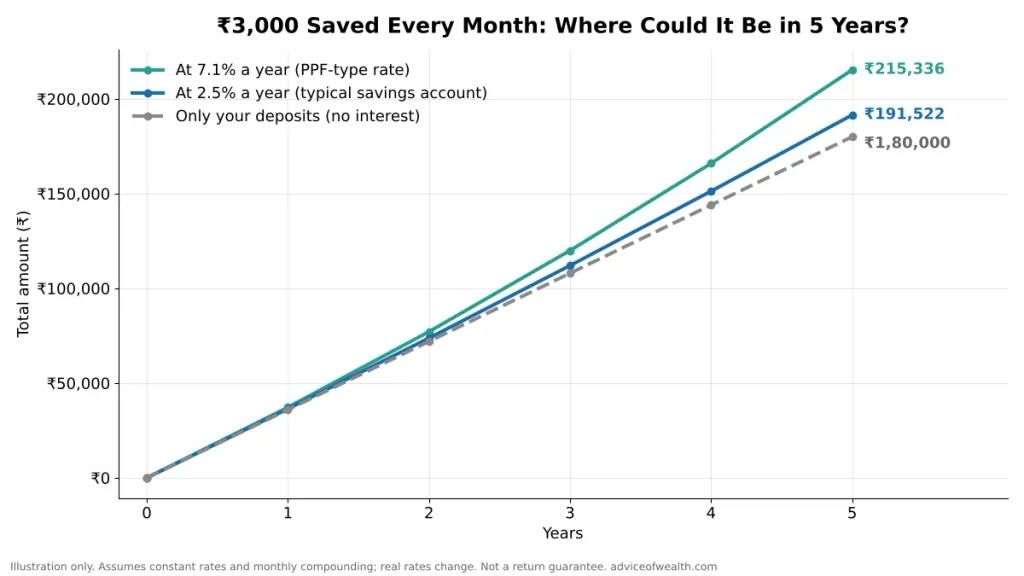
Let’s look at what a small, consistent habit can achieve. Consider Riya, a salaried employee who saves ₹3,000 every month.
Over 5 years, she accumulates ₹1,80,000 (₹3,000 × 60 months). The final amount depends on where she keeps these savings. The following examples assume that the interest rate remains constant and that interest is added on a monthly basis:
| Where the money sits | Assumed rate | Approx. value after 5 years |
|---|---|---|
| Only deposits, no interest | 0% | ₹1,80,000 |
| Typical savings account | 2.5% a year | about ₹1,91,500 |
| Higher-rate option (such as a PPF-type rate) | 7.1% a year | about ₹2,15,300 |
What does this tell you:
- The largest portion of Riya’s ₹1.8 lakh comes simply from her own regular savings.
- Interest helps, but in the early years, it is the habit [of saving] that does most of the work.
- Higher interest rates make a clear difference over the long term, but options offering higher rates often come with lock-in periods or risks.
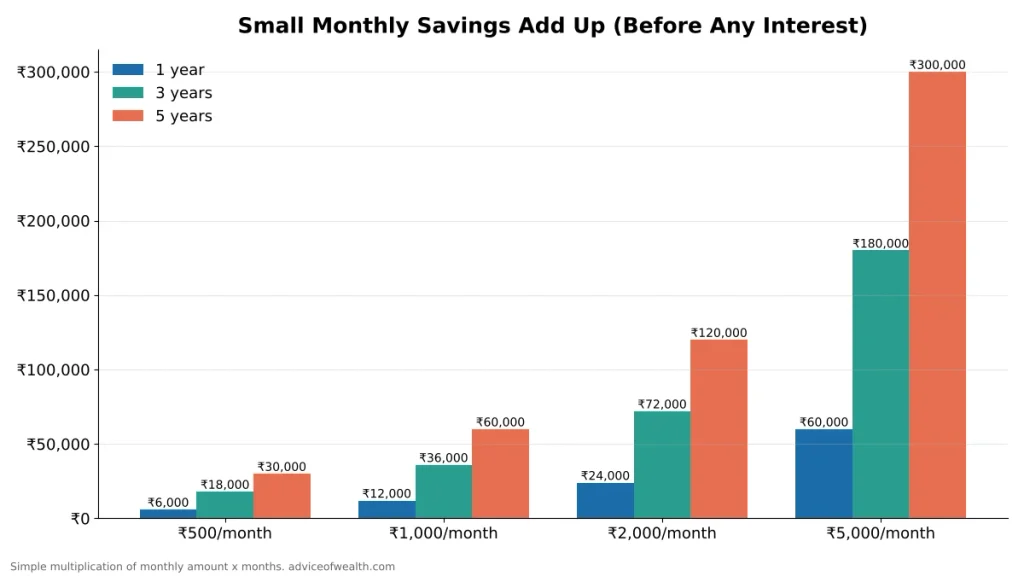
Even without any interest, small amounts grow rapidly:
| Monthly saving | After 1 year | After 3 years | After 5 years |
|---|---|---|---|
| ₹500 | ₹6,000 | ₹18,000 | ₹30,000 |
| ₹1,000 | ₹12,000 | ₹36,000 | ₹60,000 |
| ₹2,000 | ₹24,000 | ₹72,000 | ₹1,20,000 |
| ₹5,000 | ₹60,000 | ₹1,80,000 | ₹3,00,000 |
These figures are examples, not promises. Actual returns depend on the product, changes in rates, and your tax situation.
Where to Keep Your Savings in India
Different goals require your money to be placed in different places. Here is a simple guide.
Savings account
Best for your emergency fund and daily cash needs. It offers immediate access with low risk. A trade-off is that the interest rate is relatively low. Currently, major banks like SBI offer an annual interest rate of approximately 2.50% on savings accounts, though rates vary by bank and are subject to change. Check your bank’s website for their current rates.
Recurring deposit (RD)
Ideal for monthly savings with a specific goal. You deposit a fixed amount every month for a set duration. Interest rates vary by bank, and withdrawing the funds prematurely may result in a lower interest payout.
Public Provident Fund (PPF)
An excellent choice for long-term, low-risk savings. According to a report by Business Standard, the government has set the Public Provident Fund (PPF) interest rate at 7.1% for the October–December 2026 period. Since the government reviews small savings scheme interest rates every quarter, these rates are subject to change. You can find official details regarding the scheme on the National Savings Institute website. As the PPF has a 15-year tenure, it should not be used as an emergency fund.
Post Office Savings Account
This functions like a bank savings account. According to the same Business Standard report, the rate for October–December 2026 is 4%.
How safe are bank deposits?
For eligible deposits in an insured bank, the DICGC provides coverage of up to ₹5 lakh per depositor—covering both principal and interest. According to an RBI press release, this limit has been in effect since February 2020. You can review the rules on the DICGC website. If you have substantial savings, consider distributing them across different banks.
A note on tax
Interest earned on a savings account is taxable as part of your income. Under the old tax regime, a deduction was available on savings account interest (up to ₹10,000 for most individuals), but this is generally not available under the new tax regime. Tax rules are subject to change; therefore, please check the Income Tax Department’s website or consult a tax professional regarding your specific situation.
Common Beginner Mistakes to Avoid
- Waiting until you “earn more” before you start saving—this habit should be formed regardless of your current income level.
- Saving only what is left over—instead, prioritize saving first, rather than leaving it until the end.
- Keeping emergency funds in risky assets—a market downturn could occur precisely when you need the cash.
- Using your savings to cover everyday needs—set aside a separate fund for “fun” expenses so you aren’t tempted to dip into your savings.
- Mindlessly chasing the highest interest rates—higher returns usually come with greater risk or longer lock-in periods. Be wary of anyone promising high, guaranteed returns.
- Giving up after a bad month—missed a month? Just start again the following month. Don’t give up.
our 30-Day Saving Starter Plan
Use this checklist to get started:
- Days 1–3: Note down your monthly take-home salary and fixed bills.
- Days 4–7: Review your spending from the previous month and identify 2–3 areas where money is “leaking” (unnecessary expenses).
- Day 8: Open a separate savings account (or sub-account) for your savings.
- Day 10: Decide on an initial amount (even as little as ₹500) and set a specific goal.
- Day 12: Set up an automatic transfer to occur the day after you receive your salary.
- Day 15: Cancel one subscription that you no longer use.
- Day 20: Apply the “48-hour rule” to your next non-essential purchase.
- Day 30: Review what you have saved. Make a plan to increase the amount next month.
New to financial planning? Read our explainer on “What is Budgeting?” to understand the basics first.
Frequently Asked Questions
How much of my salary should I save?
A common starting point is 20% of your take-home pay, but beginners can begin with 5–10% and increase over time. Your rent, family duties, and goals decide the right number.
Is it better to save or invest first?
First, build a basic emergency fund, then start investing for long-term goals. Savings protect you from short-term setbacks, while investments aim for long-term growth, albeit with some level of risk.
How can I save money on a low income?
Start with a very small amount—for instance, ₹100 per week—and automate it. Track your spending to identify any “leaks” (unnecessary expenses), and save a portion of any extra income you receive. Consistency matters more than the amount.
Is a savings account enough to build wealth?
A savings account is excellent for security and emergencies, but it typically offers low interest. For long-term goals, people often explore other options once their emergency fund is in place. Choose these based on your risk tolerance and time horizon.
How much emergency fund do I need?
A general guideline is to set aside enough to cover 3–6 months of essential expenses. Start with a small milestone and gradually increase it.
Are my savings safe in a bank?
Deposits in DICGC-insured banks are covered up to ₹5 lakh per depositor per bank, inclusive of interest. Primary cooperative societies are not insured by the DICGC; therefore, please verify this before making a deposit.
Conclusion: Start Small, Stay Consistent
To save money, you need to follow a few key steps. Pay yourself first, automate your savings, keep them separate, and track where your money goes. Save first, invest later, and—by taking small, manageable steps—build an emergency fund that covers 3–6 months of essential expenses.
Remember Riya’s ₹3,000 per month? Through deposits alone, that grows to ₹1.8 lakh over five years. You don’t need a perfect plan; you just need to get started.
Your next step: Choose an amount today and set up your first automatic transfer. Then, read our guide on how to create a monthly budget to map out your savings plan on paper.
Disclaimer: This article is for general educational purposes only and does not constitute personalized financial, tax, or investment advice. Interest rates and tax regulations are subject to change. Please verify current details through official sources or a qualified professional before making any decisions.